Library Components#
This section explains how the different library components are structured and how they work together in a process application.
The Core: Process Engine API#
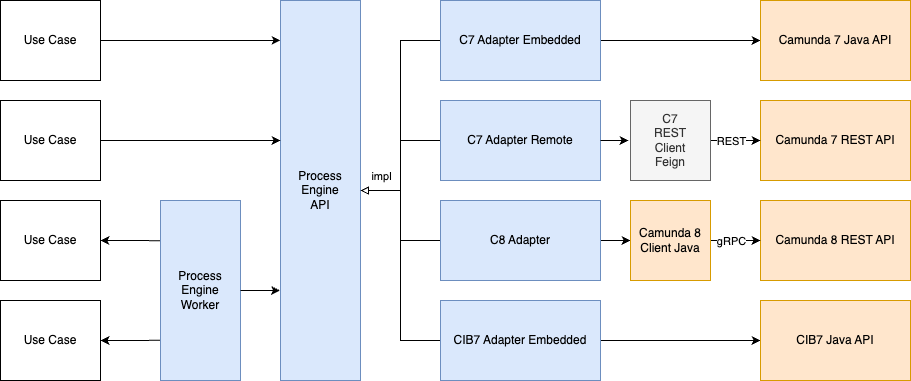
The Process Engine API is the central component of our library. It defines a set of vendor-agnostic interfaces (Ports) for common process engine operations:
- Deployment: Deploying process definitions.
- Process Instance Management: Starting, signaling, and correlating messages to process instances.
- Task Management: Completing user tasks, modifying task attributes, and handling service task completions.
- Task Subscription: Subscribing to external tasks or user tasks events.
By using these interfaces in your application's domain layer, you decouple your business logic from the specific process engine technology.
Outbound: Process Engine Adapters#
To make the Process Engine API work with a real engine, you need a Process Engine Adapter. These adapters are "drop-in" dependencies that implement the
API interfaces for a specific vendor and communication style:
- Camunda 7 Adapter: Supports both Embedded (via Java API) and Remote (via REST API) configurations.
- Camunda 8 Adapter: Integrates with Camunda 8 (SaaS or Self-Managed) using the gRPC-based Zeebe client.
- CIB Seven Adapter: Provides integration for the CIB Seven process engine.
- Operaton Adapter: Supports both Embedded (via Java API) and Remote (via REST API) configurations for the Operaton process engine.
At runtime, the application uses Dependency Inversion: your use cases depend on the Process Engine API interfaces, and the chosen adapter provides the
implementation.
Inbound: Workflow Callback Adapter: Process-Engine-Worker#
While the outbound adapters allow the application to call the engine, Workflow Callback Adapters handle the reverse: the process engine calling the application.
In a Clean Architecture setup, these adapters are responsible for:
- Receiving calls from the process engine (e.g., via a Service Task or a User Task Subscription).
- Translating the engine-specific data into domain objects.
- Invoking the appropriate application Use Case.
The Process Engine Worker is a special type of Workflow Callback Adapter that is responsible for delivering External Service Tasks to the application.
Putting it together#
When you build an application using these components, the structure typically looks like this:
- Domain/Use Case Layer: Uses the
Process Engine APIto interact with processes. - Infrastructure Layer (Outbound): Includes one of the
Process Engine Adaptersto talk to the engine. - Infrastructure Layer (Inbound): Contains
Process Engine Workersthat trigger Use Cases when the engine reaches specific points in the process.
This separation ensures that your application is future-proof: if you decide to switch from Camunda 7 to Camunda 8, you only need to change the outbound adapter dependency and configuration; your core business logic remains untouched.